- May 8, 2025
Choosing a Gas Burner
- Ray Wohlfarth
- Brewery steam systems, Steam systems
- 0 comments
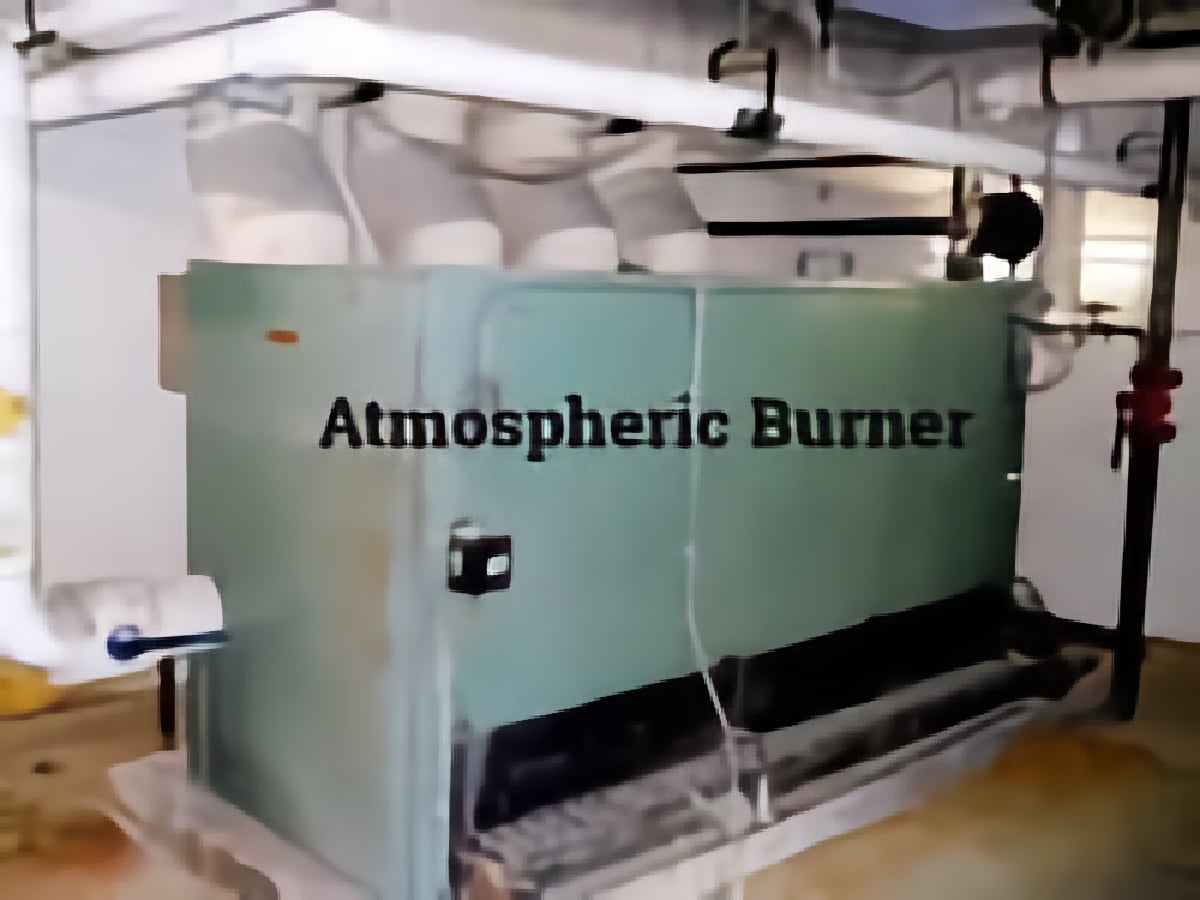
Burner Types Steam boilers will come with either an atmospheric or power burner. The less expensive atmospheric burner has a slightly lower efficiency but a quicker start time than a power burner. When a power burner starts, there is a purge time of anywhere from 30 seconds to several minutes. During the purge, the burner blows cool boiler room air into the combustion chamber to void it of combustible gases before it ignites. This can drop the temperature inside the boiler affecting the process. Boiler cycling can drop the steam pressure below what is needed for a rolling boil.A modulating or multistage burner will reduce the cycling.
Atmospheric Burner An atmospheric burner uses the velocity of the gas to mix the proper amount of air to the boiler for the burn cycle. It has no fan and the off time losses could be greater than a power burner. It is like the flame on the top of a gas stove. The main advantage to an atmospheric burner is it can start quickly without a pre-purge common on power burners. This allows a more steady steam supply.
Power Burner A power burner uses an internal fan to introduce air to the combustion process. While it requires more electricity to burn the fuel, the added electrical costs are offset by the lower fuel costs. The following are the types of burner firing options you will find in the field.
On-Off The burner starts when there is a call for heat. Once the setpoint of the operating pressure control is reached, the burner will shut off. An On-Off burner is usually the least expensive type of burner but it allows wider swings of the pressure inside the boiler.
Low High Off (LHO) This burner starts at low fire for smoother ignition and once the flame is established will travel to high fire and stay there until the call for heat has ended. This is a two position burner.
Low High Low (LHL) This burner starts at low fire and when the flame is established will travel to high fire. It will stay at high fire until it reaches the pressure setpoint on the firing rate control. At the setpoint, the burner drops to low fire until the call for heat ends or the pressure at the sensor of the firing rate control drops low enough to drive it to high fire again. The firing rate control is usually set at a lower setpoint than the operating and limit control. For example, the firing rate control on a typical brewery steam boiler may be set at 10 pounds while the operating control will be set slightly higher, say 11 Psig. The manual reset pressure control will be set even higher than the operating control. This is a two position burner. According to Honeywell, a Low High Low burner will be 15% more efficient than a modulating burner.
Modulating This burner will start at low fire and then travel to high fire until it reaches the firing rate pressure control setpoint. At the setpoint, it will vary the firing rate anywhere from high fire to low fire depending upon the signal from the firing rate control. This is a multi-position burner.
What is Turndown? If you are like me, it is what happened when you asked your children to clean their rooms. When it pertains to burners, it is quite different. Burner turndown is the percentage of the high fire rate the burner can safely reduce to. The lowest firing point is called Low Fire. Let us assume we are going to purchase a 100,000 Btuh boiler and the supplier has the three following options:
· Boiler #1 has a 2-1 turndown
· Boiler #2 has a 5-1 turndown
· Boiler #3 has a 10-1 turndown
What does turndown mean?
Boiler #1, 2-1 Turndown Burner can reduce the firing from 100,000 to 50,000 Btuh.
Boiler #2 - 5-1 Turndown Burner can reduce the firing rate from 100,000 to 20,000 Btuh.
Boiler #3 - 10-1 Burner can reduce the firing rate from 100,000 to 10,000 Btuh.
The higher the turndown, the less the boiler cycles. This helps when you need a consistent pressure in the boiler. The firing rate of the multi-position burner is controlled by either the firing rate or modulating control.